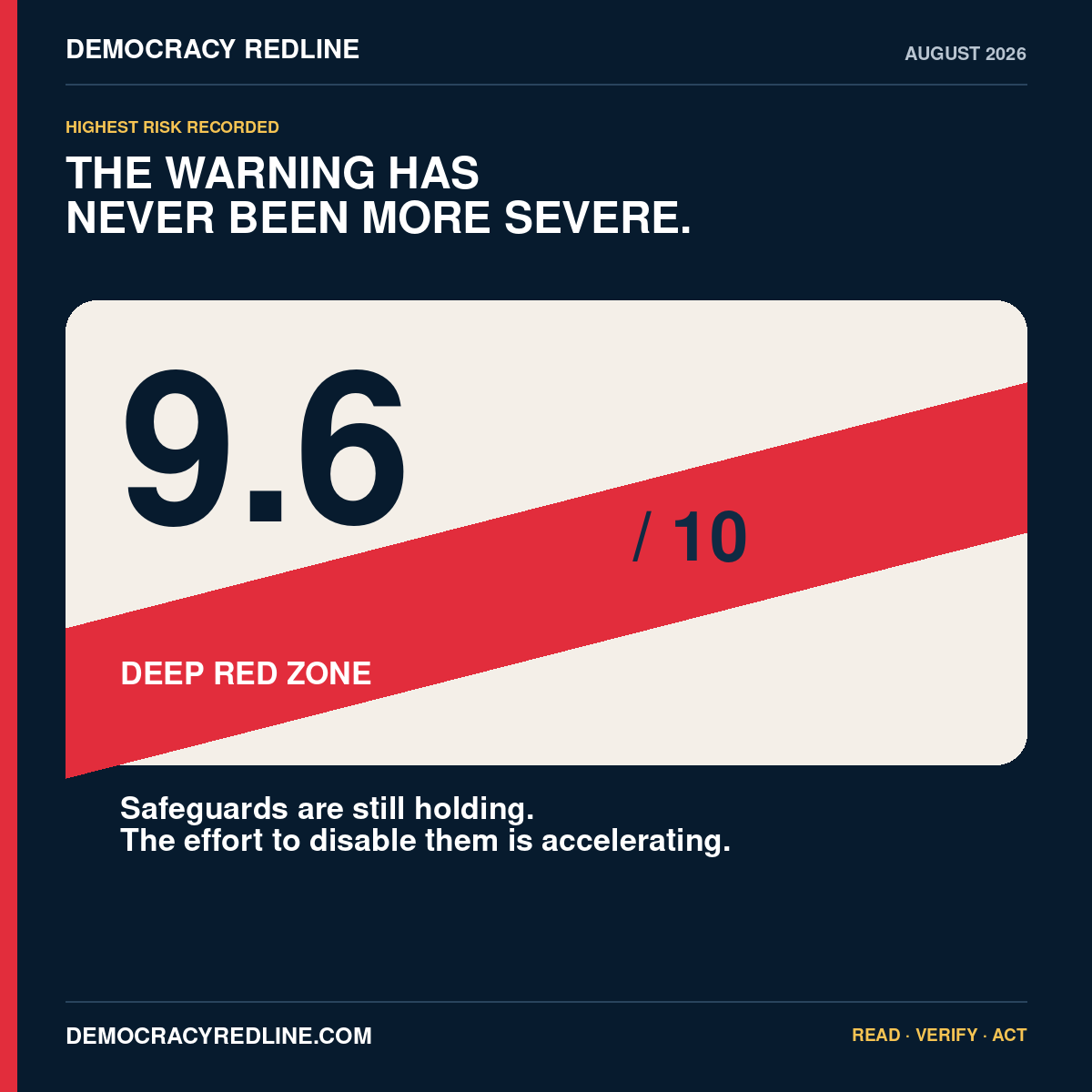
Understand the warning
Read the current analysis, formal report, archive, and methodology so the score has context.
Jump to understanding tools
Democracy Redline is meant to help readers move from concern to clarity. This resource hub gives you a practical path: understand the score, inspect the evidence, compare outside trackers, take lawful civic action, and share the warning without exaggeration.
The resource library is organized around the reader journey. Start with the warning, verify what supports it, widen the lens with outside sources, then choose a lawful and useful next step.
Read the current analysis, formal report, archive, and methodology so the score has context.
Jump to understanding toolsUse the evidence hub and outside democracy trackers to compare the project against public records and independent research.
Jump to evidence resourcesMove concern into practical civic behavior: contact officials, support guardrails, volunteer locally, and protect reliable information.
Jump to action resourcesUse copy-ready language and graphics designed to inform people without rumor, rage, or partisan overreach.
Jump to share tools
Essays, satire, and visual arguments that expose authoritarian logic, answer bad-faith claims, and make propaganda easier to recognize.
An editorial project from Democracy Redline. Distinct from formal reports, evidence, and scoring.
Explore Democracy DeprogrammingDemocratic backsliding is cumulative. The best way to read this site is to compare the current score against the monthly archive, the evidence spine, formal reports, and outside trackers. This page is built to make that comparison easier.
The Resources page helps readers learn, verify, act, and share. Editorial Standards & Corrections explains how Democracy Redline evaluates evidence, includes meaningful counterevidence, keeps human judgment accountable, corrects errors, and preserves the public record.
Resources help people verify claims. Democracy Deprogramming helps people understand the rhetoric, fallacies, psychology, and marketing tricks that make anti-democratic ideas sound normal.
These are the core Democracy Redline pages for reading the current warning, comparing month-to-month movement, and understanding how the score is produced.
Start here for the current month’s public warning, top score drivers, countervailing brakes, and category movement.
Open latest analysisUse formal reports for the structured monthly record, durable summaries, and downloadable PDFs.
Open report libraryCompare July against June, May, April, and the earlier backfilled baseline to see progression, persistence, and acceleration.
Open archiveSee the nine-category rubric, weighted framework, risk bands, evidence discipline, and monthly review process.
Read methodologyThese visuals give readers a shared vocabulary before they dive into monthly scores, reports, and outside sources. Click or tap the images to enlarge them.
This chart maps government systems across several dimensions at once: who holds power, where sovereignty sits, how institutions are structured, and what economic or social arrangements shape public life.
Democratic backsliding rarely announces itself as a clean switch from “democracy” to “dictatorship.” Erosion usually appears as movement inside the system: weakened checks, concentrated executive power, captured institutions, degraded civil liberties, or elections that remain in place while the safeguards around them shrink.
Use this chart as a reader’s orientation tool. It shows why the project focuses less on labels and more on institutional behavior: whether power is accountable, rights are protected, elections are meaningful, and the rule of law can still constrain those who govern.


This chart focuses inside the democracy spectrum. It shows the institutional frameworks that make democratic government meaningful: representative government, fundamental rights, checks on government, impartial administration, and participatory engagement.
A country can still hold elections while weakening courts, press freedom, civil liberties, administrative neutrality, or the public’s ability to participate. When those supports erode together, the system may still look democratic on the surface while becoming less capable of protecting popular control and political equality.
The monthly score is designed to watch that interaction. It asks whether democratic institutions are reinforcing one another, or whether failures in one area are beginning to cascade into others.
These links help readers compare Democracy Redline’s monthly warning against independent democracy indices, watchdog work, legal trackers, election administration resources, press freedom measures, and public-opinion research.
Democracy Redline uses a weighted monthly rubric and editorial review. Outside sources help establish context, corroborate patterns, and identify candidate developments, but the monthly score depends on category relevance, documentation quality, severity, institutional reach, and repeat-pattern value.
The internal evidence hub explains what counts as evidence, what does not, and how monthly evidence notes support the score.
Open evidence hubA major global democracy measurement project useful for understanding democratic decline, autocratization patterns, and comparative context.
Read V-Dem reportA public tracker for following executive actions and institutional developments relevant to the current U.S. stress test.
Open TrumpTrackerComparative democracy data, reports, and autocratization research across countries and time.
Open V-DemAnnual ratings and analysis of political rights and civil liberties around the world.
Open Freedom in the WorldRecurring expert and public surveys focused on the performance of democratic principles in the United States.
Open Bright Line WatchA useful comparison of multiple democracy indicators showing U.S. democratic decline in 2025.
Read Pew analysisGlobal democracy ranking tracking electoral process, civil liberties, political culture, participation, and government functioning.
Open EIU indexA framework for separating authoritarian warning signs from ordinary political conflict.
Read the playbookInstitutional analysis of executive power, courts, national security, rule of law, and constitutional conflict.
Open LawfareSupreme Court case tracking, argument coverage, decisions, and legal context.
Open SCOTUSblogResearch on courts, voting rights, election administration, redistricting, money in politics, and democratic reform.
Open Brennan CenterA live tracker of authoritarian-action patterns and democratic pushback in the United States.
Open threat trackerCoverage and analysis focused on voting rights, elections, and election litigation in the courts.
Open Democracy DocketState-level voting law analysis and resources for understanding election administration changes.
Open Voting Rights LabNonpartisan state-legislature resources on election law, administration, and state-level policy changes.
Open NCSL electionsResearch and analysis on voting access, election administration, redistricting, and democratic participation.
Open voting-rights researchGlobal tracking of press freedom, useful for monitoring one of Democracy Redline’s key institutional categories.
Open press freedom indexLegal and advocacy work around civil liberties, due process, voting rights, protest rights, and constitutional protections.
Open ACLUPublic opinion research on institutional trust, democracy, polarization, rights, and political behavior.
Open Pew democracy researchPolling and public-opinion research on government, democracy, trust, civic life, and current events.
Open AP-NORCLong-running public opinion data on trust in institutions, confidence in government, and democratic attitudes.
Open Gallup government topicsDemocracy Redline does not promote threats, harassment, intimidation, or illegal activity. The action resources are designed to support institutional defense, public accountability, and peaceful civic participation.
Copy-ready scripts, action levels, and lawful next steps for contacting officials and supporting democratic guardrails.
Open Action ToolkitUse official lookup tools to identify your elected officials before calling, writing, or attending public meetings.
Find official lookup linksLocal meetings, letters, volunteering, civic groups, election protection, and support for independent journalism all matter.
Choose an action levelFocus on institutions, oversight, rights, elections, courts, and public accountability. Do not escalate into threats or intimidation.
Read the missionThe purpose of this page is to widen the lens. Democracy Redline still does its own monthly scoring work, but the project is strongest when readers can compare that warning against foundational civic frameworks, independent indices, legal trackers, watchdog work, and public records.
An independent monthly warning system tracking democratic stress in the United States.