The final pre-Red Zone baseline widened across multiple institutions.
March moved the index from 8.4 to 8.9 as press freedom, election administration, court compliance, executive power, and military/intelligence neutrality all sharpened as risk categories.
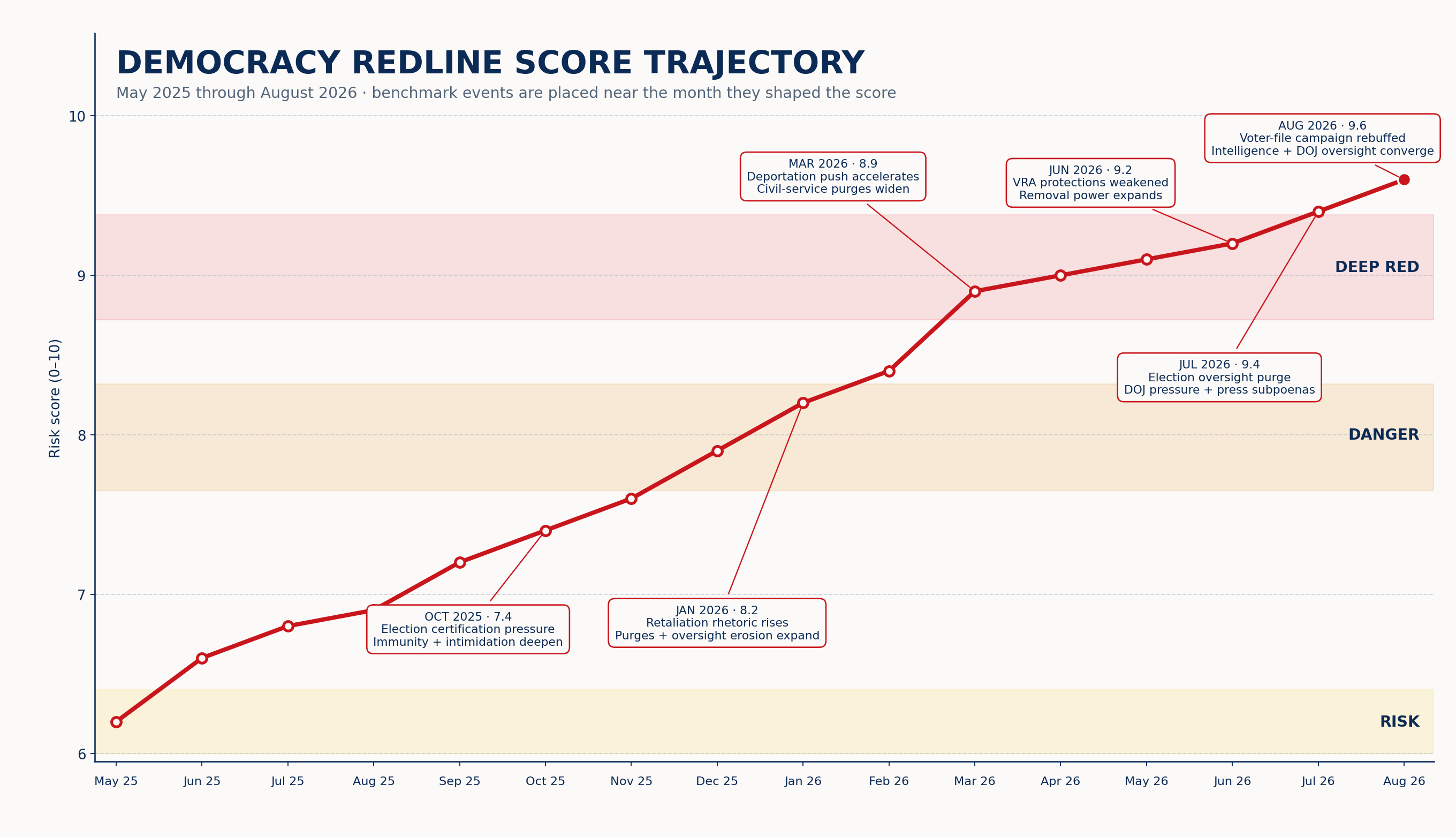
Historical trajectory context. March 2026 recorded 8.9 / 10.
What changed this month?
The March scorecard described a broader escalation across press freedom, election administration, court compliance, and executive power. The report stated that March moved the index from 8.4 to 8.9 because a triggered press-freedom redline and a new federal-election-override Watch signal widened the danger pattern beyond domains that had already deteriorated earlier in the month.
Top score drivers
Triggered: The March report identified journalist charges for routine reporting as a triggered redline indicator.
Watch: Federal override of certified election results moved to Watch, broadening the pattern into election administration.
Severe: The March category scorecard recorded Military / Intelligence Neutrality at 8.8.
Severe: Rule of Law & Court Compliance was recorded at 8.7, keeping courts and compliance near the top of the risk stack.
Category scorecard
| Category | Status / score | Interpretation |
|---|---|---|
| Rule of Law & Court Compliance | 8.7 | Court compliance remained one of the highest-risk categories. |
| Habeas Corpus & Due Process | 8.5 | Due-process risk remained at a severe level. |
| Coercive State Power | 8.2 | Coercive state power continued to rise. |
| Weaponized Justice | 8.0 | Justice-system pressure was in the severe-erosion band. |
| Election Integrity | 8.6 | Election-administration risk intensified sharply. |
| Press Freedom | 7.4 | Press freedom rose alongside the triggered journalist-charges indicator. |
| Civil Society | 6.8 | Civil-society risk remained elevated. |
| Institutional Oversight | 8.0 | Oversight was in the severe-erosion band. |
| Military / Intelligence Neutrality | 8.8 | The highest March category, one step below explicit Red Zone territory. |
Key evidence and benchmark events
- The March scorecard recorded Military / Intelligence Neutrality at 8.8.
- Rule of Law & Court Compliance was recorded at 8.7.
- Election Integrity was recorded at 8.6.
- The Redline Tracker marked journalists criminally charged for routine reporting as Triggered.
- The Redline Tracker marked federal override of certified election results as Watch.
What moved the meter
The meter rose sharply because March no longer read as a one-domain spike. The highest categories included military/intelligence neutrality, rule-of-law and court compliance, election integrity, due process, and coercive state power. The report kept the system just below formal breakdown risk, but warned that further redline movement could produce a faster jump than ordinary monthly drift.
What to watch next
- Court orders: Whether court orders produced visible compliance steps, deadlines, and consequences for delay.
- Routine reporting: Whether criminalizing ordinary protest coverage triggered coordinated legal and civic response.
- Election records and custody: Whether ballots, equipment, and certification records stayed inside lawful procedures with transparent oversight.
How this score is grounded
The score is a structured civic-risk judgment based on the public record and the source stack described in the methodology. It is not a poll, a prediction, or a claim that every institution has failed.
Observable public actions, court rulings, official statements, documented enforcement activity, and major reporting.
Why those events matter for democratic function, institutional independence, civil liberties, and rule-of-law constraints.
How the evidence affected the monthly risk assessment, especially when categories reinforced one another.
Evidence and source credibility
This formal report uses the published February/March scorecard record already present in the production package and the same source-category framework described in the methodology: official records, court actions, watchdog reports, major journalism, election administration sources, civil liberties organizations, and democracy-index references.
Methodology note
Published-scorecard backfills align earlier scorecard records to the current Democracy Redline report structure. They preserve the verified score, category readings, redline indicators, and trajectory context already present in the production archive.

An independent monthly warning system tracking democratic stress in the United States.