A critical baseline formed before the March acceleration.
February held the index in a critical range, with sustained structural stress around court compliance, detention due process, coercive state power, and election governance.
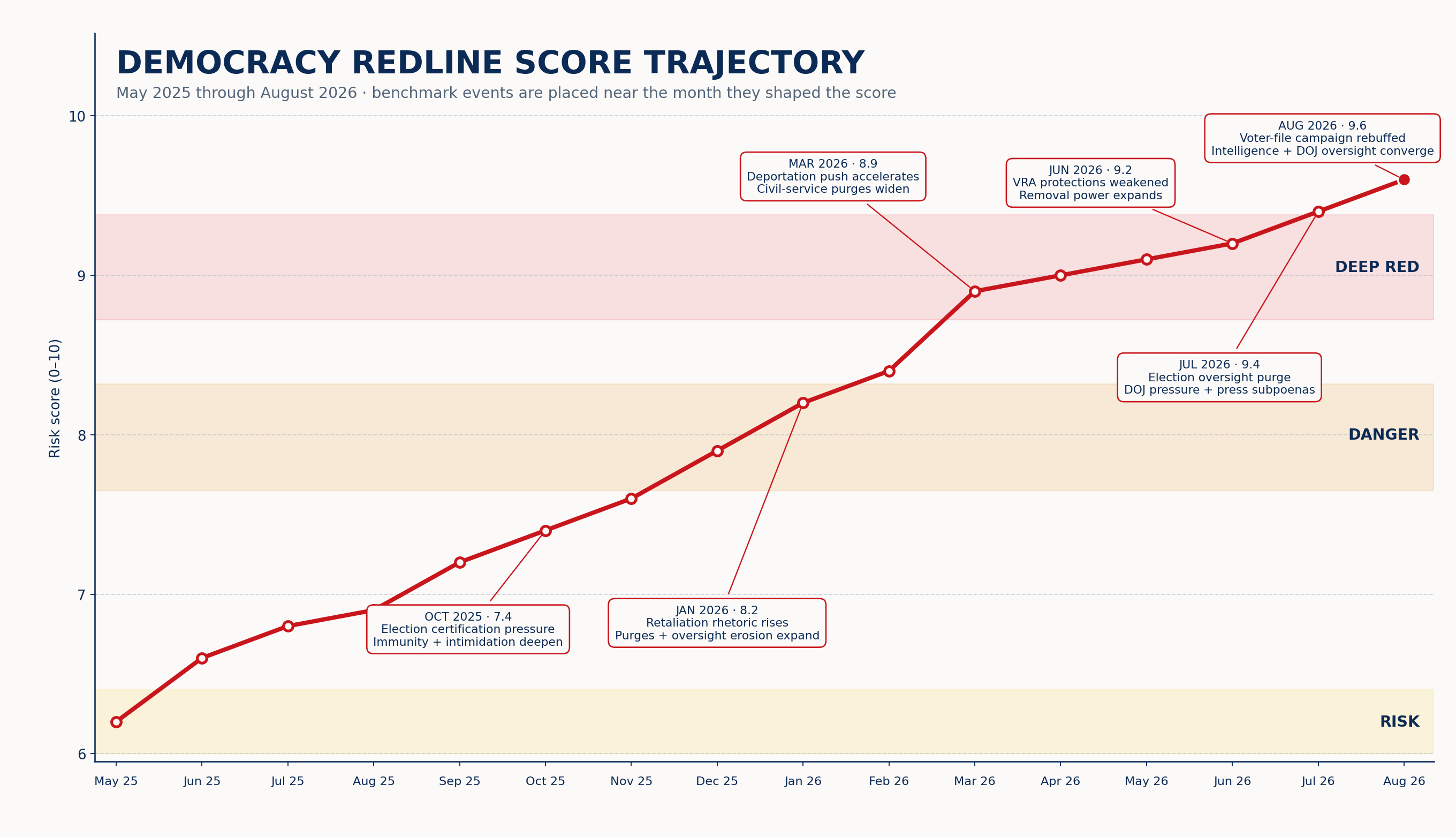
Historical trajectory context. February 2026 recorded 8.4 / 10.
What changed this month?
The February scorecard described democratic institutions as operational but under sustained structural stress. The strongest pressure appeared around court compliance, detention due process, and election governance, with several immediate redline indicators listed as escalation triggers if they moved from warning signs into open constitutional breach.
Top score drivers
Critical: The published scorecard placed Rule of Law & Court Compliance at 8.5, one of the highest category readings.
Critical: Habeas Corpus & Due Process was also recorded at 8.5, making procedural rights a central score driver.
Severe: Coercive State Power reached 8.0, keeping state authority and enforcement posture in the severe-erosion band.
High: Election Integrity was recorded at 7.6, signaling that election administration was already a material risk category before March.
Category scorecard
| Category | Status / score | Interpretation |
|---|---|---|
| Rule of Law & Court Compliance | 8.5 | One of the highest readings in the February scorecard. |
| Habeas Corpus & Due Process | 8.5 | Due-process access remained a core critical-range driver. |
| Coercive State Power | 8.0 | State-power pressure was in the severe-erosion band. |
| Weaponized Justice | 7.8 | Justice-system pressure remained high risk. |
| Election Integrity | 7.6 | Election governance was a significant elevated-risk category. |
| Press Freedom | 6.8 | Below the top risk tier but close enough to remain a watch category. |
| Civil Society | 6.7 | Civil-society pressure remained elevated. |
| Institutional Oversight | 7.2 | Oversight remained in the severe-erosion band. |
| Military Neutrality | 6.2 | Military neutrality was elevated but below the most severe February categories. |
Key evidence and benchmark events
- The February scorecard recorded Rule of Law & Court Compliance at 8.5.
- Habeas Corpus & Due Process was also recorded at 8.5.
- Coercive State Power was recorded at 8.0, keeping state-power risk in the severe-erosion range.
- Election Integrity was recorded at 7.6 as an active governance risk category.
- The scorecard listed immediate escalation triggers including open defiance of a final Supreme Court order, functional habeas inaccessibility, federal override of certified election results, criminal charges against journalists for reporting, and intelligence use for domestic political surveillance.
What moved the meter
The score remained in a critical range because rule-of-law and due-process categories sat at 8.5 while coercive state power, weaponized justice, and election integrity also remained elevated. The record still treated the immediate redline indicators as triggers rather than fully activated breakdown events.
What to watch next
- Court compliance: Whether final court orders were obeyed or openly defied.
- Habeas access: Whether counsel and habeas rights remained practically reachable in real time.
- Election administration: Whether elevated election-integrity risk turned into active override or certification conflict.
How this score is grounded
The score is a structured civic-risk judgment based on the public record and the source stack described in the methodology. It is not a poll, a prediction, or a claim that every institution has failed.
Observable public actions, court rulings, official statements, documented enforcement activity, and major reporting.
Why those events matter for democratic function, institutional independence, civil liberties, and rule-of-law constraints.
How the evidence affected the monthly risk assessment, especially when categories reinforced one another.
Evidence and source credibility
This formal report uses the published February/March scorecard record already present in the production package and the same source-category framework described in the methodology: official records, court actions, watchdog reports, major journalism, election administration sources, civil liberties organizations, and democracy-index references.
Methodology note
Published-scorecard backfills align earlier scorecard records to the current Democracy Redline report structure. They preserve the verified score, category readings, redline indicators, and trajectory context already present in the production archive.
An independent monthly warning system tracking democratic stress in the United States.