Due process and enforcement pressure pushed High Risk toward Critical.
December was more structurally severe than November, with sharper collisions between enforcement power, due process, and institutional independence.
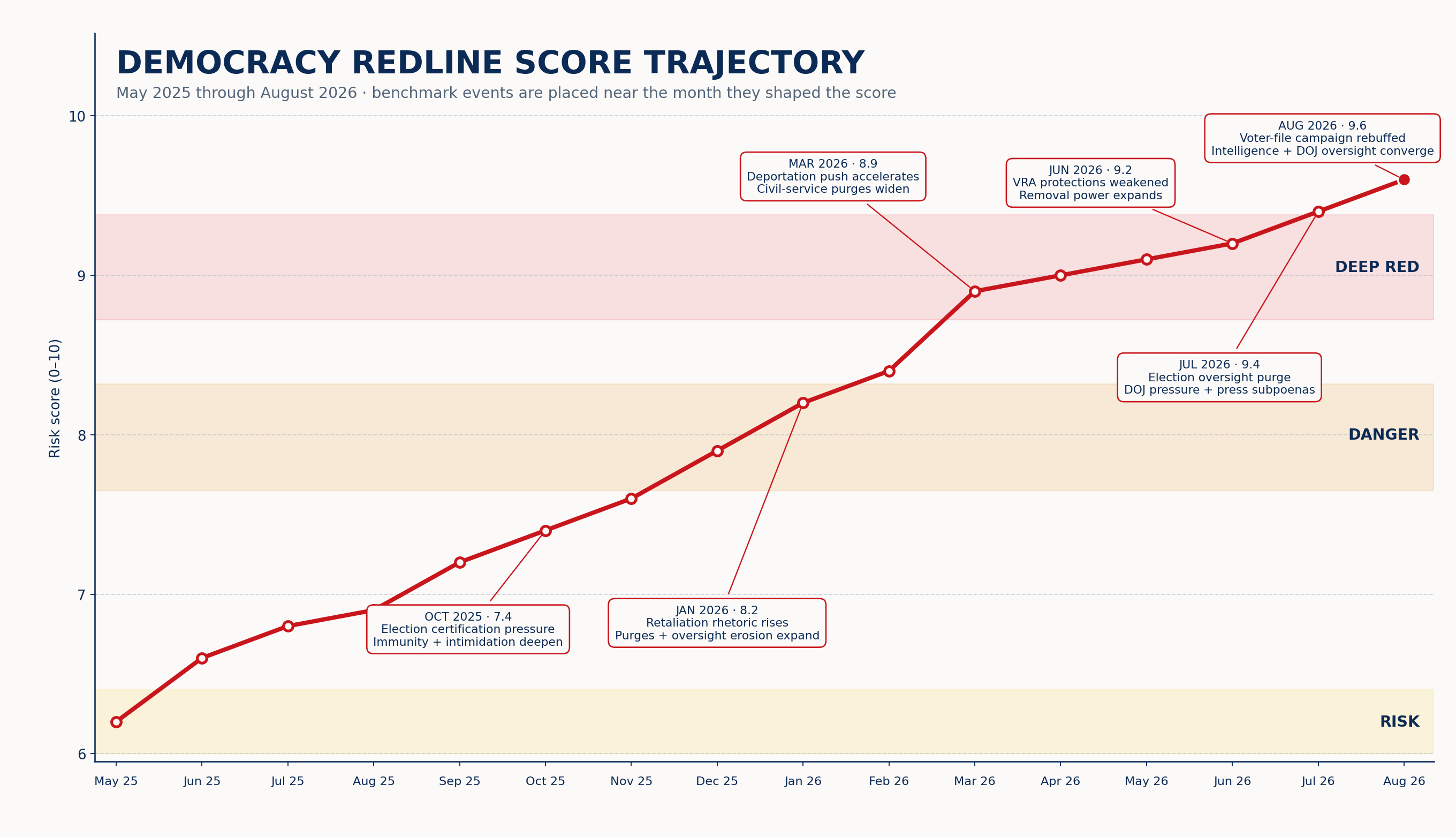
Historical trajectory context. December 2025 recorded 7.9 / 10.
What changed this month?
December widened the pattern from pressure signals into a more direct collision between enforcement authority, immigration power, due process, and institutional independence.
Top score drivers
Worsening: The contempt proceeding and rapid-deportation disputes kept legal-process constraints at the center.
Worsening: TPS and family-reunification actions expanded the scope of immigration-policy stress.
Worsening: The retribution tracker described a broader pattern of punitive government actions.
Active: Federal courts still blocked or revived proceedings in ways that materially constrained government action.
Category scorecard
| Category | Status | Interpretation |
|---|---|---|
| Rule of law and due process | Critical | Deportation, contempt, and rapid-removal litigation drove the month upward. |
| Immigration authority | High | Multiple immigration-policy actions widened the rights and process concerns. |
| Institutional independence | High | Punitive firings and revoked clearances suggested broader pressure on independent actors. |
| Executive power and enforcement | High | Enforcement power collided more visibly with judicial constraints. |
| Countervailing checks | Active | Court intervention remained meaningful, but did not reverse the broader direction. |
| Civil liberties and equal protection | High | Family-reunification and TPS actions expanded the human-rights stakes of the period. |
Key evidence and benchmark events
- Judge James Boasberg revived the contempt proceeding over deportation flights.
- A federal appeals court blocked the administration's bid to expand rapid deportations nationwide.
- The administration imposed and defended a $100,000 H-1B visa fee, prompting a multistate legal challenge.
- DHS ended Temporary Protected Status for Ethiopians and stopped processing legacy family-reunification cases.
- Reuters' retribution tracker documented a widening pattern of punitive firings, investigations, and revoked clearances.
What moved the meter
The meter rose because due-process conflicts and punitive institutional pressure became harder to treat as isolated episodes. Court intervention supplied meaningful resistance, but not enough to reverse the broader escalation.
What to watch next
- Court compliance: Whether court limits around deportation and contempt translated into durable constraint.
- Retaliation pattern: Whether punitive firings, investigations, and clearance actions continued to widen.
- Immigration scope: Whether rapid-removal and TPS actions remained isolated or became governing pattern.
How this score is grounded
The score is a structured civic-risk judgment based on the public record for the monthly period. It is not a poll, a prediction, or a claim that every institution has failed. The report weighs documented events by severity, category, persistence, and whether multiple stress signals are moving together.
Observable public actions, court rulings, official statements, documented enforcement activity, and major reporting.
Why those events matter for democratic function, institutional independence, civil liberties, and rule-of-law constraints.
How the evidence affected the monthly risk assessment, especially when categories reinforced one another.
Evidence and source credibility
Backfilled formal reports rely on recovered archive content and the same source stack described in the methodology: official records, court actions, watchdog and civil-liberties sources, election-administration material, democracy-index references, and major journalism where it helps document public events.
Methodology note
Backfilled formal reports use the current Democracy Redline scoring framework to reconstruct earlier trajectory. Where recovered report text was available, this page uses that recovered content. These records are best read as trajectory documents that show sequence, persistence, and accumulation across months.

An independent monthly warning system tracking democratic stress in the United States.