June 2026 · 9.2 / 10
June deepened the Red Zone again as election integrity, due process, coercive state power, and military-intelligence neutrality worsened further.
The archive is where a warning system becomes credible. It lets readers compare months, measure velocity, and see how democratic erosion accumulates through sequence rather than one headline at a time.
The current live monthly warning. Today, that is the June 2026 analysis.
The month-by-month trajectory record, including published months and retrospective backfilled analysis.
Formal report-style pages designed for deeper reading, sharing, and later PDF conversion.
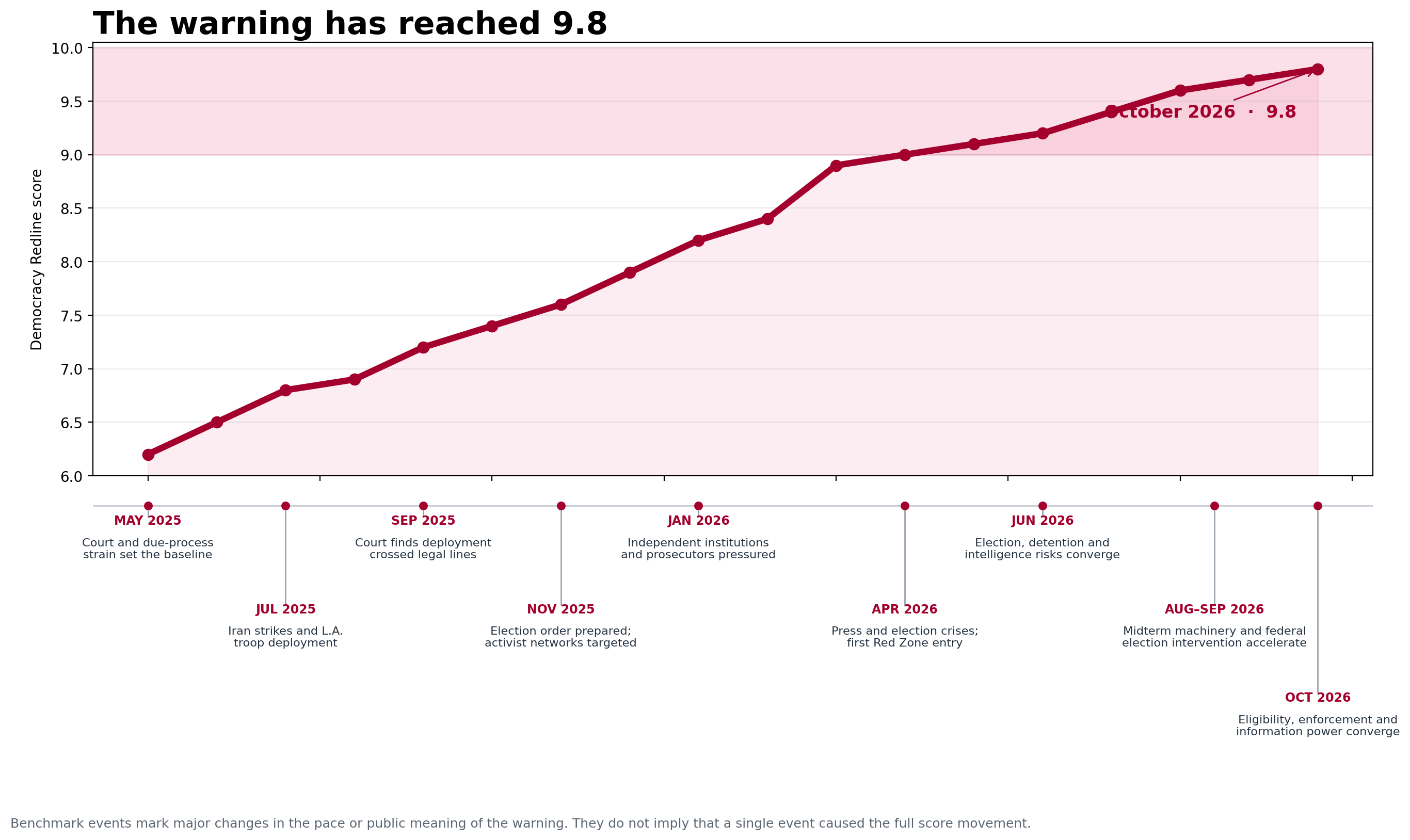
A progression from elevated concern into a sustained Red Zone reading.
Start with the latest month, then step backward to see how the risk accumulated.
Democratic stress is easier to understand as a sequence than as isolated headlines.
June deepened the Red Zone again as election integrity, due process, coercive state power, and military-intelligence neutrality worsened further.
May confirmed the Red Zone pattern as election fairness, due process, institutional checks, and war-powers accountability all worsened further after April crossed the threshold.
April moved the U.S. into explicit Red Zone territory and introduced the public model’s countervailing-check framework.
The last public score before the official Red Zone entry, useful for comparing what changed as the warning intensified.
The published baseline before the sharp late-winter acceleration across multiple categories.
Critical-range institutional stress, with pressure around federal independence, legal constraints, and personnel strain inside government service.
A sharper collision between enforcement authority, immigration power, due process, and institutional independence.
Rising pressure across immigration authority, election administration, political retaliation concerns, and institutional behavior under executive pressure.
The move into High Risk, driven by domestic-terror framing, deployment litigation, and widening federal-state conflict.
The low-7s shift as courts confronted the legality of federalized domestic deployment.
A plateau month when deployment and enforcement pressures normalized rather than receded.
Sustained summer escalation across war-powers, immigration, deployment, and local-authority conflicts.
The sharpest early backfill rise as immigration raids, protests, and National Guard deployment converged.
The twelve-month backfill starting point, already elevated before the sharper summer escalation.